
This month, our new(ish) communications volunteer, Sylvia Black, is our guest blog writer!
When I (Anneke) attended the Canadian Nutrition Society conference recently, a keynote speaker (and beef farmer) made a casual observation: that people are not going to eat less beef. I even wrote the quotation in my notebook, because the lack of substantiation took me by surprise: “less beef isn’t going to happen.” From my perspective, the assumption that behaviour change is impossible is treacherous, because it invites despair, complacency, and a cycle of fear, fatalism, and inaction. Also, it’s false! Consumer behaviour changes all the time–we just don’t see it often in the news. Recognizing that diets change is crucial to envisioning possible food and climate futures.
Enjoy Sylvia’s excellent post!
The recipe for a climate-friendly diet (in broad terms) is pretty simple: fewer animal products and more plant-based foods. But how realistic is it to expect Canadians to change their diets in this way? Are people really going to eat fewer hamburgers? We can’t predict the future, but we can gain some insight into what’s possible by looking at how dietary trends have already changed in the past.
Unfortunately, we don’t have rigorous data on Canadian food consumption over the years. But we do have the next best thing: comprehensive data on food availability in Canada dating back to 1960. This data (from Statistics Canada) measures the amounts of different foods that were available per person in Canada each year. Of course, some food gets wasted instead of being eaten, so this isn’t a perfect measure of dietary intakes, but since food supply tends to follow demand for different products, it’s a good rough approximation.
So what do the data show?
Canadians Are Eating Far Less Beef
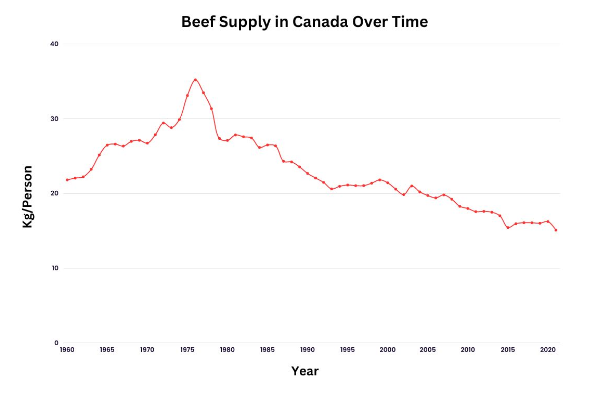
Beef availability in Canada peaked in 1976 at over 35 kg per person*
As of 2021, the food supply provided less than half of that amount (per capita)–only 15 kg per person–and it looks likely to continue decreasing in the future.
The cause is probably a combination of price, health concerns, and environmental concerns, so we can’t attribute the trend to climate awareness alone. However, this is evidence that society can make significant dietary changes at the population level over time, and likely with consistent messaging. Whatever the exact combination of reasons, the fact that beef consumption is declining is good news for the climate.
Instead, We’re Eating Chicken
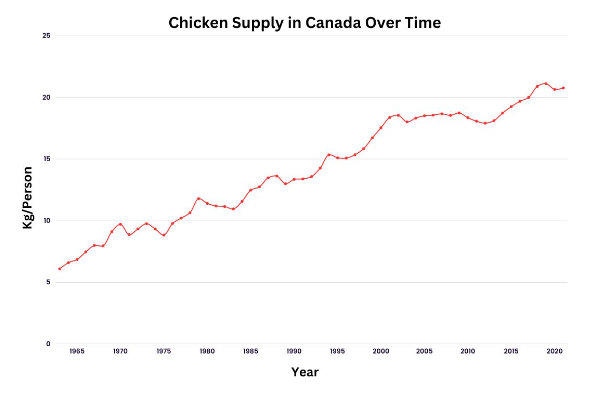
Chicken has seen a dramatic increase from just over 6 kg/person in 1963 to nearly 21 kg/person in 2021*. Chicken’s lower price and perceived healthfulness are probably the main reasons for this.
From a climate perspective, the carbon emissions associated with poultry production are in between those associated with beef on the one hand, and plant proteins like legumes on the other. To the extent that chicken has displaced beef in the Canadian diet, this is a good thing for the climate, but to achieve further emissions reduction (especially as populations increase), chicken intake will likely need to decrease as well, in favour of more plant protein foods.
Plant-Based Proteins Make Up a Small Percentage of Canadian Diets
Unfortunately, the historical data on plant protein availability is not as robust as what we have for meat. However, according to data from Public Health Ontario, plant-based proteins make up only 1-2% of the average Canadian diet as of 2021. Despite changes in which types of meat people are eating, animal-based foods still make up the vast majority of protein in most people’s diets.
There are health as well as environmental reasons to encourage most people to consume more legumes and other plant-based proteins. The good news is that dietitians are well placed across practice areas to influence this: whether in individual counselling, public health units, government agencies, institutional settings, food industry organizations, non-profits, academia, or other settings, there are plenty of opportunities to encourage plant-based protein consumption, make it more available, and increase the appeal. And what we can take from the data we’ve seen is that big shifts are possible at the population level. Given the right combination of factors in the food environment, there’s every reason to think that we can shift Canadian diets to support climate change mitigation.
*Boneless weight, before spoilage and waste
Sources:
-
Statistics Canada. Table 32-10-0054-01 Food available in Canada DOI: https://doi.org/10.25318/3210005401-eng
-
Ontario Agency for Health Protection and Promotion (Public Health Ontario). What’s on the plate? Exploring dietary intakes in Ontario in relation to the 2019 Canada’s Food Guide. Toronto, ON: Queen’s Printer for Ontario; 2021. https://www.publichealthontario.ca/-/media/documents/w/2021/whats-on-the-plate.pdf?sc_lang=en