
This month, our nutrition student volunteer, Natalie Nguyen, contributed to our blog again! Here she unpacks a commonly conflated view on sustainable food: the assumption that food that is healthy is also environmentally sustainable.
Have you come across the phrase “What’s good for you is good for the planet”? This is a great example of how the media conflates nutritious diets and sustainable/climate-friendly diets. From Time to Ted Talks (by Dean Ornish), we’re told that eating to improve the planet’s health is also how we should eat to improve our own health. The reality is not so simple–climate-friendly diets don’t work for everyone, and sometimes nutrition and sustainability are in conflict. Eating a diet that’s mostly grains has a low impact on the environment, for example, but won’t meet our nutritional needs. Alternatively, someone could be eating a diet that’s rich in fresh fish and produce, but this would have a large environmental footprint if these items were flown long distances by air, grown in heated greenhouses over the winter, cooked inefficiently, and generate lots of food waste.
There are also recommendations out there that aren’t great for health or the environment, yet they might appear true because they give clear and simple instructions. One of these is to eat less food. Project Drawdown’s “Plant-Rich Diets” solution, for example, recommends consuming 2300 calories a day, and attempts to combine climate action with weight loss. Capping consumption at 2300 calories doesn’t meet everyone’s needs, and counting calories daily can be a slippery slope to disordered eating. Most dietitians will tell you that caloric intake is not a good indicator of health, and in fact, calories themselves aren’t meaningfully linked to greenhouse gas emissions (GHGs) either. (You can read more about this, and our case for why dietitians are essential to climate-friendly diets right here on our blog!)
First, let’s explore what a nutritious diet is. Nutritious diets are those that maximize health benefits and reduce the risk of developing diseases. According to Canada’s Food Guide, a nutritious diet includes plenty of fruit and vegetables, protein foods (especially plant proteins), whole grains, and water as the drink of choice (Health Canada, 2019). The food guide also recommends limiting highly processed foods with a lot of sodium, sugar, and saturated fat. Many diets recommended for health promotion are also plant-rich, and tend to be climate-friendly. Aside from Canada’s Food Guide, these include the Mediterranean diet, the Portfolio diet, and the DASH diet.
When it comes to sustainable diets, several indicators are used: GHGs, land use, water use, and more. Low environmental impact is ideal in most diets, as this preserves biodiversity and ecosystems, enabling sustainable food production for future generations (Public Health Ontario, 2021). In climate-friendly diets, GHGs are the focus, although land use is included in impact calculations as well (because often agricultural land, like livestock pasture, replaces carbon sinks, like a forest). Minimizing food waste is another important consideration, since food waste is also a waste of all the inputs used to produce that food (such as energy, cropland, water, fertilizer, and pesticides) and contributes to GHG emissions (Conrad, 2020).
While there’s definitely overlap between the two factors of nutrition and environmental impact, the criteria for these diets differ: nutritious diets are not always climate-friendly, and climate-friendly diets are not always nutritious. We can think of 4 categories of diets based on a continuum of these two factors:
-
Low-nutrient, high-impact diets
-
Low-nutrient, low-impact diets
-
Nutritious, high-impact diets
-
Nutritious, low-impact diets
The characteristics of these different diets are summarized below.
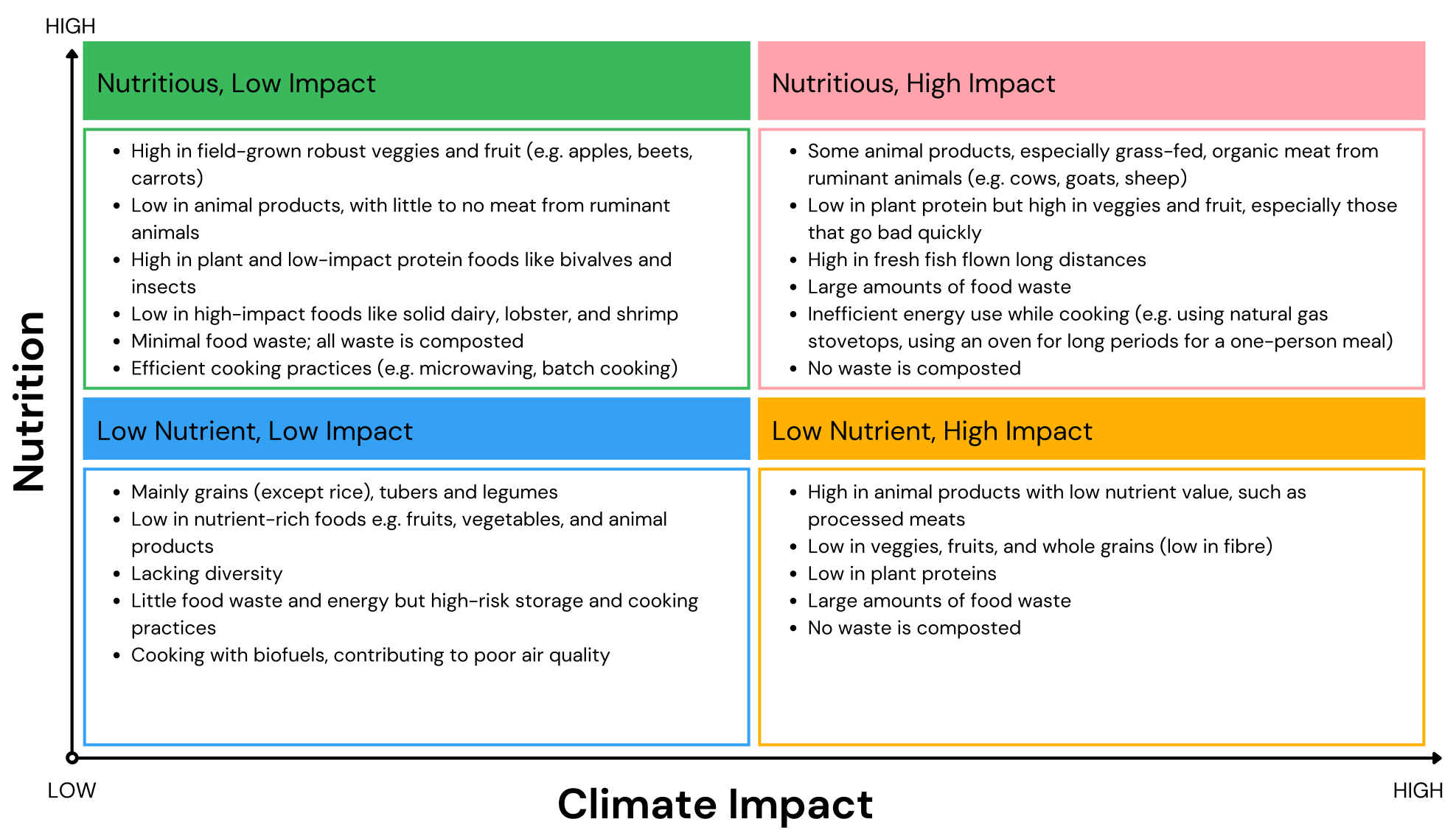
Adapted from Tara Garnett (Food Climate Research Network).
Nutritious and low-emission diets are ideal when we consider both health and sustainability. But this is not an easy switch for everyone to make, and some of the traits will be easier to implement than others. This is another reason dietitians are needed in the crafting of messages and the implementation of new programs or policies. Food insecurity and financial instability limit food choices (Vilar-Compte et al., 2021). Industry and interest-group promotion of high-emission foods can bury healthier, climate-friendly choices, and decrease awareness (Miller et al., 2021). However, there are simple steps that can be taken to move towards a nutritious, low-emissions diet that may already be part of your or your clients’ regular routine. Some examples include using the microwave to cook, experimenting with tofu, lentils, and chickpeas, and preventing food waste by transforming leftovers or sharing food.
References
Conrad, Z. (2020). Food waste, healthy diets, and environmental sustainability: a guide for nutritionists. Nutrition Today, 55(1), 5-10.
Health Canada. (2019). Canada’s food guide. Retrieved from https://food-guide.canada.ca/en/.
Miller, K. B., Eckberg, J. O., Decker, E. A., & Marinangeli, C. P. (2021). Role of food industry in promoting healthy and sustainable diets. Nutrients, 13(8), 2740.
Public Health Ontario. (2021). The environmental impacts of sustainable dietary patterns. Ontario Agency for Health Protection and Promotion. Toronto, ON: Queen’s Printer for Ontario.
Vilar-Compte, M., Burrola-Méndez, S., Lozano-Marrufo, A., Ferré-Eguiluz, I., Flores, D., Gaitán-Rossi, P., Teruel, G., & Pérez-Escamilla, R. (2021). Urban poverty and nutrition challenges associated with accessibility to a healthy diet: a global systematic literature review. International Journal for Equity in Health, 20, 1-19.