
In recent years you may have noticed a rise in the popularity of food waste reduction apps, like Too Good To Go, or produce boxes that reroute “rescued” groceries due to overproduction or cosmetic standards, like Odd Bunch. This may reflect an increase in our collective awareness of a significant issue – food waste.
Dietitians for Climate Action covered this topic back in 2022 through an interview with University of Guelph researcher, Dr. Kate Parizeau, and thought it would be worthwhile to revisit now.
Food waste (FW) refers to edible food that is wasted or lost at some point along the supply chain. It has been described as a multifactorial problem with consequences for the environment (climate change and environmental degradation from “wasted” natural resources), and the economy (the total value of Canada’s avoidable FW has been estimated at upwards of $58 billion annually), as well as social and health costs (related to food insecurity and loss of nutrients with wasted food).
It is also a global issue that is listed as one of the United Nation’s Sustainable Development Goals, has its own day – “International Day of Awareness of Food Loss and Waste Reduction on September 29”, and is on the radar of governments around the globe. Worldwide, 20% of food produced for human consumption is wasted or the equivalent of 1 billion meals per day (UNEP).
In terms of climate change, FW is responsible for 8-10% of annual greenhouse gas emissions as of 2024 estimates (UNEP). This is three times the global emissions from aviation, or if FW emissions were a country, it would be the world’s third largest emitter after China and the United States. Sadly, this is also up from 6% of global greenhouse gas emissions in 2020 (Ritchie 2020).
Here in Canada, 46.5% of all the food produced for our country goes to waste (Gooch et al. 2024). You read that right – nearly half of all the food produced for Canada is wasted in the end. Of course, some food waste is unavoidable – things like bones, vegetable peelings, egg shells, coffee grounds, etc. But, of all the food wasted in Canada, nearly 90% is avoidable.
Where exactly is the FW occurring? The figure below shows the breakdown in percentage and tonnage (in millions) of Canadian FW, with “processing/manufacturing” accounting for 49% and “households” coming in second at 15%. And of household FW, 63% is considered avoidable, costing an average single-family household over $1300 per year and equivalent to over 200kg! (lovefoodhatewaste.ca).
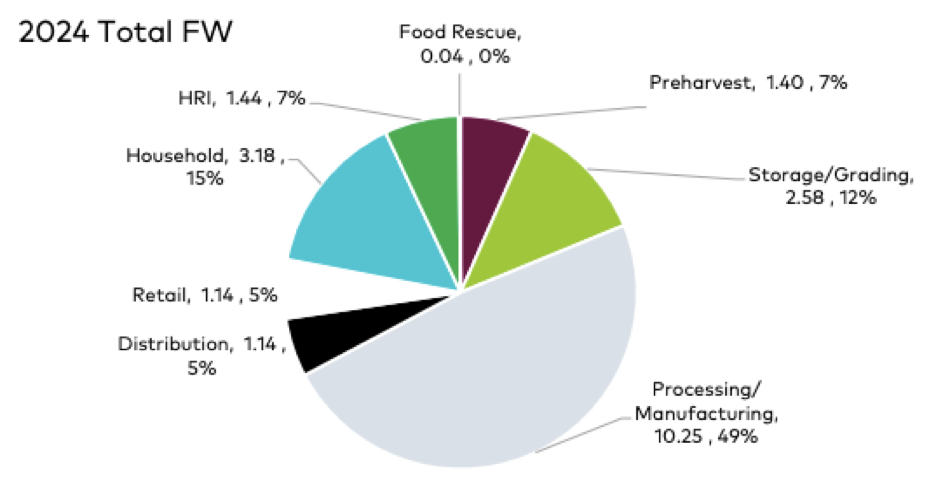
(Image from: Gooch et al. 2024)
Although this is a global issue, the statistics do not look the same everywhere – the United States discards more food than any other country every year with an estimated 43% coming from homes.
Addressing Food Waste
As a systemic issue, proposed solutions to FW should be aimed at various points along the food system and include collaboration between all levels of government, businesses and individuals. Rethinking our linear food system and moving towards a circular one that shifts away from valuing food as a commodity has also been proposed as key to sustainably address FW.
It’s important to note that interventions aimed at reducing FW at one point may actually be implemented at a different one. For example, changes to package labeling or size that influence consumers to discard less food at home would be implemented by the processor and not the household itself (Read et al. 2020). In other words, reducing consumer FW doesn’t necessarily require consumers to make all the changes. This is somewhat positive news because, as we all know, behaviour change is hard and education campaigns aimed directly at the consumer, like Love Food Hate Waste, are expensive and have rarely been shown to have persistent effects (Read et al. 2020). (Love Food Hate Waste is focused on increasing food skills related to planning meals, using up foods and keeping foods fresh).
This is disappointing to hear given that Toronto (where I live) has utilized Love Food Hate Waste since 2018 as part of a multi-pronged approach to educate residents about FW and no data on whether this has translated into actual FW reduction is currently available.
Another point to note is that much of the research on consumer level FW reduction is quite limited or local in scope which may not translate to a larger scale. Accurately measuring household food waste is also a challenge. Many studies rely on estimates and use aggregate data collected at municipal or even higher levels. Others may look at the household level, but via self-report, which we know tends towards under-report and inaccuracies. Direct measurement studies (i.e. where food waste is actually physically measured) give the most accurate data, but are costly and labour and time intensive and as a result, tend to be conducted on a small scale.
Even the effectiveness of individual interventions may vary from region-to-region. This is understandable knowing that consumer behaviour towards FW is a complex mix of multiple factors including: values, cultural norms, family dynamics, household composition, economic context, urban infrastructure (Salume et al. 2026). Still, it is a commonly studied area, so let’s look at some of the household level food waste interventions that have been looked at.
Consumer-level Interventions
Improved understanding of best before dates (BBDs). Misuse and misunderstanding of BBDs are actually responsible for 23% of avoidable FW in Canada (Gooch et al. 2024). Today, consumers view BBDs as an indication of product value and safety and not as a representation of a product’s peak quality, like when it was introduced in the 1970s. BBDs are not the same as expiration dates and are determined by manufacturers and retailers, not by food safety regulations. If a package has not been opened, even after the BBD, it can still be of good quality and freshness, as long as it has been stored properly.
Similarly, with produce (the most wasted food type in Canadian households – see graphic below), you may be tossing what doesn’t look pristine, out of caution for food safety. But do you need to toss the whole clamshell of berries if just one or two is moldy? The website eatortoss.com is a handy resource to help you reduce FW by offering answers to this and other questions, with science-backed explanations and a touch of food science.
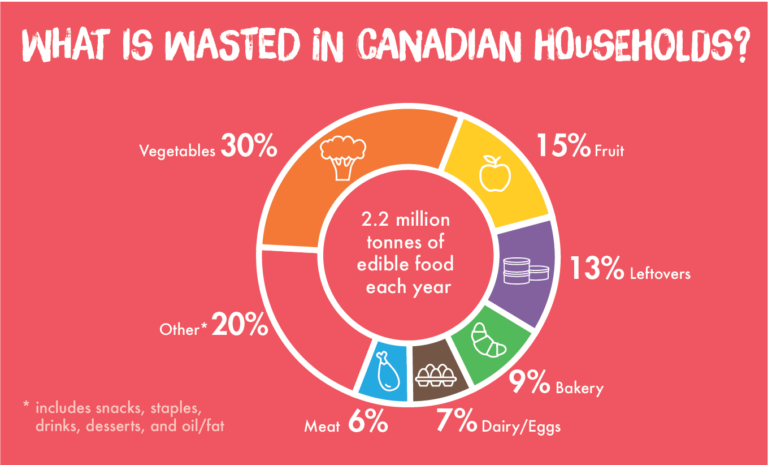
(Image from lovefoodhatewaste.ca)
Addressing a culture of simply accepting waste. A study looking at consumer behaviour towards FW in Ireland found that “uncaring” consumers produced twice as much weekly FW compared to “caring” consumers (Flanagan 2021). Similarly, others have found households with a higher awareness of FW as a social problem, produced less FW (Parizeau et al. 2015).
Interventions to educate consumers on the consequences of FW face the challenge of which consequence to highlight. With increased public awareness of environmental issues like climate change, framing FW reduction as a sustainability issue may be beneficial for some, but at the same time, highlighting cost savings may be more motivating for others. These were exactly the findings of a pilot study conducted in London, Ontario – “Reduce Food Waste, Save Money”. This underscores the challenge of implementing education campaigns at the consumer level – different groups may respond best to different angles of the FW problem.
Utilizing FW reduction apps, but cautiously. Some popular ones include: Flashfood, FoodHero and Too Good To Go. Each with a slightly different business model, they share the appeal of “gamifying” food rescue by tracking estimated climate impact and motivating more environmentally sustainable habits. While they can save you money, they can also encourage impulse purchases for food that won’t necessarily be eaten and move the burden of FW onto the consumer. A 2025 study by Yang and Yu found that surprise bags (like what you get with Too Good To Go) can reduce store waste (sometimes to zero), but this can also/often get passed on to the consumer. A review by Hanson and Ahmadi (2021) also noted FW reduction apps can assist consumers to reduce their FW if they also have adequate time, resources and awareness of FW in the first place, but can pull focus away from the need for integrated and multifaceted interventions at government, industry and individual levels.
Manufacturing/Retail Interventions
Recently, there has been a lot of attention on food waste from food retailers like grocery stores and restaurants, especially with rising grocery costs. And we know that manufacturing is the largest contributor to FW in Canada. So what is being done in these areas? We’ll cover this in our next newsletter in “Food Waste – Part 2” where we’ll take a deeper dive into regulations and policies around corporate food donation, and upcycling food waste.
Take Away
Food waste is a significant global issue, with many negative consequences including significant contributions to global GHG emissions as well as other environmental, social and economic impacts.
Action is required from players along the entire food supply chain, including consumers. No singular strategy exists to reduce household FW due to varying characteristics between households and complex interaction between food system participants. Strategies to consider include: increasing food skills around planning, using and storing foods; understanding the meaning of best before dates and in some situations using FW reduction apps. Still, these downstream actions shouldn’t take away from the need for a holistic approach in evaluating and preventing food waste.
References:
CBC News (Jan 23, 2025). How food waste apps can help the climate and save you money. Retrieved from https://www.cbc.ca/news/science/what-on-earth-food-waste-apps-1.7439246
Everitt H, et al. (2021). The quantity and composition of household food waste during the COVID-19 pandemic: A direct measurement study in Canada. Socioecon Plann Sci. Retrieved from: https://pmc.ncbi.nlm.nih.gov/articles/PMC9192138/
Flanagan A and Priyadarshini A. (2021). A study of consumer behaviour towards food-waste in Ireland: Attitudes, quantities and global warming potentials. Journal of Environmental Management. Retrieved from: https://www.sciencedirect.com/science/article/pii/S0301479721001080?via%3Dihub
Food Waste, City of Toronto. https://www.toronto.ca/services-payments/recycling-organics-garbage/waste-management/waste-reduction/food-waste/
Food Waste in America in 2026. Recycle Track Systems. Retrieved from: https://www.rts.com/resources/guides/food-waste-america/
Gooch M, Nikkel L, Bucknell D, et al. (2024). The avoidable crisis of food waste update; Second harvest and value chain management international; Ontario, Canada. Retrieved from: https://cdn.prod.website-files.com/6618114bae6895cc12d3dc1d/671695f108d9e689b40723a0_acfw-technical-updated.pdf
Hanson V and Ahmadi L. (2021). Mobile applications to reduce food waste within Canada: A review. The Canadian Geographer. 66(2). Retrieved from: https://www.researchgate.net/publication/357023057_Mobile_applications_to_reduce_food_waste_within_Canada_A_review
Li B, Maclaren V and Soma T. (2020). Urban household food waste: drivers and practices in Toronto, Canada. British Food Journal. Retrieved from: https://foodsystemslab.ca/wp-content/uploads/2023/04/Li-et-al.-2021-Urban-household-food-waste-drivers-and-practices.pdf
Parizeau K, von Massow M and Martin R. (2015). Household-level dynamics of food waste production and related beliefs, attitudes, and behaviours in Guelph, Ontario. Waste Management, v35; 207-217. Retrieved from: https://api.liveugconthub.uoguelph.dev/sites/default/files/migration/ug_profile/files/inline_files/Parizeau%20et%20al.%202015%20(Waste%20Management)%20-%20Accepted%20version.pdf
Ritchie H. (2020) “Food waste is responsible for 6% of global greenhouse gas emissions” Published online at OurWorldinData.org. Retrieved from: ‘https://archive.ourworldindata.org/20251125-173858/food-waste-emissions.html’ [Online Resource] (archived on November 25, 2025).
Soma, T. (2022). Critical food guidance for tackling food waste in Canada: A closed-loop food system alternative to the food recovery hierarchy approach. Canadian Food Studies. Retrieved from: https://canadianfoodstudies.uwaterloo.ca/index.php/cfs/article/view/490/633
Soma T, Li B and Maclaren V. (2020). Food waste reduction: A test of three consumer awareness interventions. Sustainability. Retrieved from: https://www.mdpi.com/2071-1050/12/3/907
Salume P, Barbosa M and de Rezende Pinto M. (2026). Food waste and consumer behaviour: A bibliometric and review study and future research directions. Retrieved from: https://pmc.ncbi.nlm.nih.gov/articles/PMC12841053/
Taking a bite out of food waste. Communications. Ivey / Impact. July 9, 2024. Retrieved from: https://www.ivey.uwo.ca/impact/read/2024/07/taking-a-bite-out-of-food-waste/
UNEP Food Waste Index Report 2024 Key Messages. UN environment programme knowledge repository. Retrieved from: https://wedocs.unep.org/rest/api/core/bitstreams/5a45a93c-93b9-4606-a9db-ed69d7158931/content
Van der Werf P, Larsen K, Seabrook J and Gilliland J. (2020). How neighbourhood food environments and a pay-as-you-throw (PAYT) waste program impact household food waste disposal in the city of Toronto. Sustainability. Retrieved from: https://www.mdpi.com/2071-1050/12/17/7016
Von Massow M, Parizeau K, Gallant M et. al. (2019). Valuing the multiple impacts of household food waste. Front Nutr. Retrieved from: https://pmc.ncbi.nlm.nih.gov/articles/PMC6738328/
Yang L and Yu M. (2025). Too good to go: Combating food waste with surprise clearance. Management Science. Retrieved from: https://pubsonline.informs.org/doi/full/10.1287/mnsc.2023.03001