
This post was researched and drafted by our amazing dietitian volunteer Sarah Dales, and revised and edited by Anneke Hobson! Thank you for this update Sarah!
Let’s get back into food waste! No matter where you work as a dietitian, food waste and finding ways to reduce it is likely on your radar, and possibly in your job description. In Part One, Sarah showed that food waste is a complex issue with many negative consequences, including contributing significantly to greenhouse gas emissions (8-10% of annual global emissions!). The total emissions that food waste generates (directly and indirectly) account for more than all of the emissions from road transportation and nearly five times as much as the entire aviation sector! Also, you can see at Our World In Data that Canada wastes even more food than other developed countries like the US. This makes what we call “food use” a huge climate action opportunity for Canadians–one in which dietitians are key players.
At DCA, we sometimes refer to “food use” based on a perspective laid out in the Washington Post a couple of years ago to reframe the label from what to avoid (“waste”) to what we want people to do, ie, use the food you buy/acquire, and buy food you’re realistically going to use. Repurpose it, share it, etc.
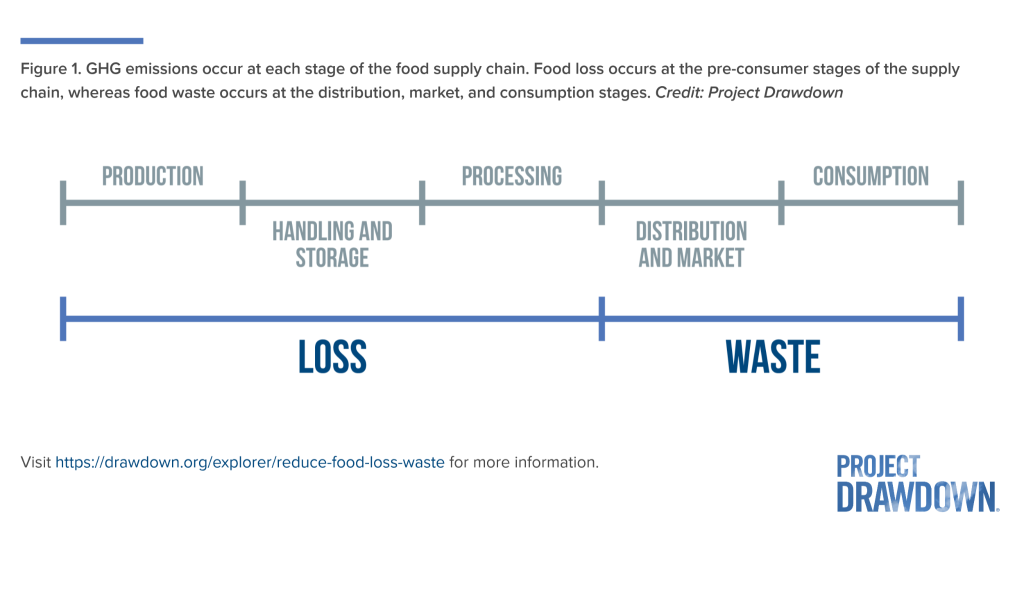
In many of our webinars and presentations over the past few years, we’ve stated that individual households are the biggest contributors to food waste in Canada. However, figuring out where food is wasted or lost depends on how you categorize it, and things are changing! We found this graphic from Drawdown Explorer extremely helpful to understanding the categories:
(Drawdown Explorer, 2026)
While households have a significant role to play in reducing food waste, if we zoom out to the full picture of food loss and waste, much of the total in Canada is currently occurring upstream: 49% at the processing and manufacturing level (Gooch et al. 2024). This means our previous claims may have been misleading to dietitians: while consumers and individuals are the main sources of food waste, the larger umbrella of “food loss and waste” shifts the numbers. Here we’ll take a closer look at why industry is such a large source of food waste and what is being done to address it.
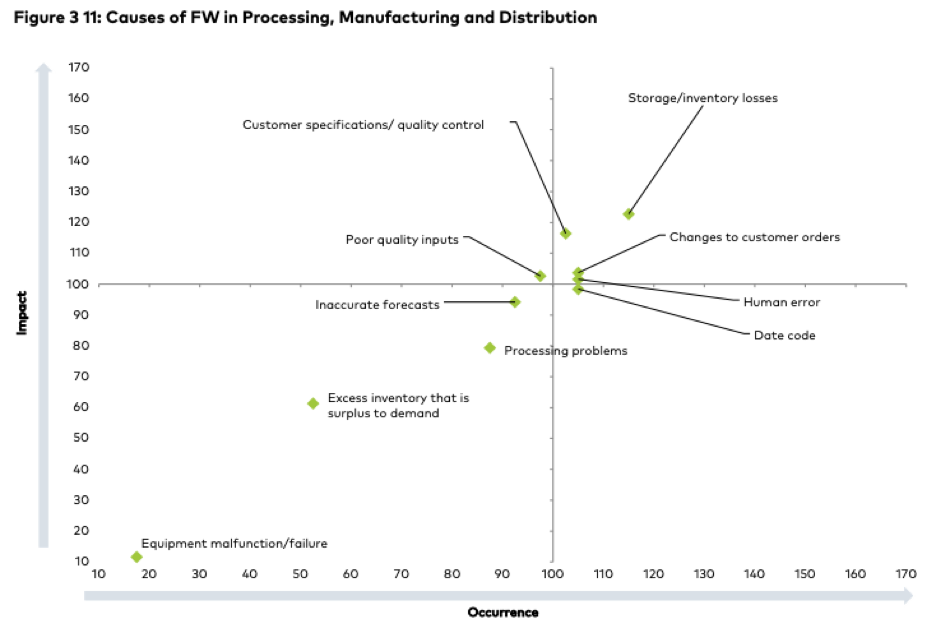
According to Second Harvest’s 2024 report, “The Avoidable Crisis of Food Waste – Update,” the top food waste contributor in the Processing, Manufacturing and Distribution sector is storage/inventory losses, followed by customer specifications/quality control. Changes to orders, human error, and data coding all sit closely as other high impact and high occurrence causes (see image below from Gooch et. al, 2024).
Storage/Inventory Losses
Why does loss happen here? Delivery delays (related to time and distance for transport) is a common challenge. Damage during transport, inadequate temperature/humidity control (worsened by weather changes, increasing temperatures and aging equipment), spillage during transfers, and rodents and other pests spoiling products are other causes. When these occur, particularly with fresh produce, food products can end up being rejected by retailers or wasted for food safety reasons.
Customer specifications/Quality control
This cause of food loss has multiple drivers and is a much-discussed area for improvement. One area is related to retailers’ (e.g. grocery stores) use of specific “minimal life on receipt” (MLOR) targets for products. MLORs are based on date codes (best before dates and expiry dates) and from a retailer’s perspective are to help ensure items don’t expire on their shelves before purchase. But MLORs are not standardized, and can vary vastly from one retailer to another, resulting in suppliers having trouble providing products in time to meet the various MLORs, leading to wasted product.
One strategy to counteract this is having retailers accept certain perishable products in frozen form to help extend their shelf-life (which may explain why I’ve started seeing my favourite brand of bread defrosting on the shelf recently).
Another aspect of “customer specifications” relates to grading of products like fresh produce. While the Canadian Food Inspection Agency sets grading standards on characteristics like size, colour, shape, etc., retailers frequently require these to be exceeded in a desire to market “premium” products to customers. Produce that doesn’t meet these cosmetic standards still tend to share the same internal qualities and nutrition as those that do. This has snowballed with the current high cost of groceries, resulting in customers coming to expect that any produce they purchase should be pristine if they will be paying more for it. As a result, produce that could be harvested, but doesn’t meet grading requirements, simply isn’t.
At the same time, climate change is making it harder for producers to deliver on these high standards. The 2024 Second Harvest report documented an occurrence of a whole crop of cantaloupes and honeydew melons (85,000 lbs!) being rejected and going unsold because they were less than half an inch under the requested size as a result of higher temperatures and smoke from forest fires.
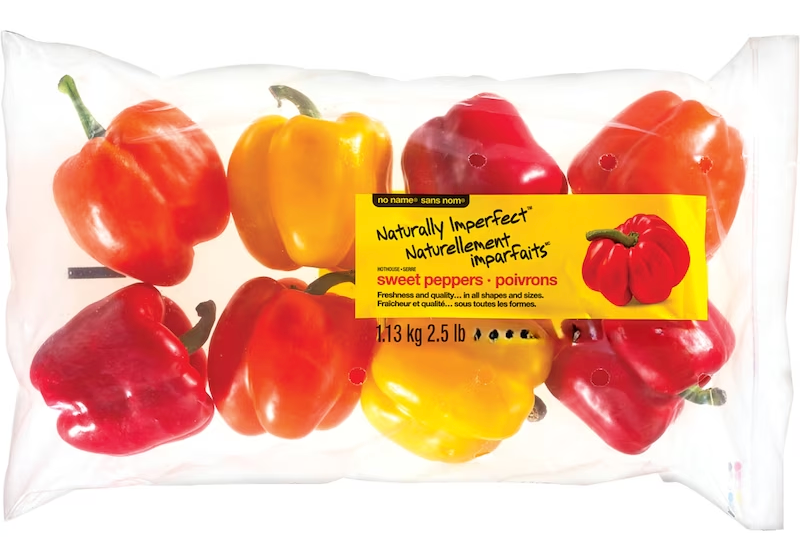
One solution is marketing “imperfect” produce at a lower cost (e.g. “naturally imperfect” produce at Loblaw company stores, which in my experience, often look similar to the produce that has been deemed to meet the standards). This helps producers redirect otherwise surplus produce, helps grocers appear more environmentally-conscious and provides shoppers with a more affordable and equally nutritious alternative. Similarly, Odd Bunch is an example of a weekly produce box service with imperfect and surplus produce offered at a lower cost (up to 50% off retail).
Another contributor to food loss is byproducts or production waste that manufacturing processes are just not set up to use. According to ReFED (a nonprofit dedicated to ending food loss and waste), almost 90% of surplus food in processing can be attributed to byproducts and production line waste. While diverting the byproducts to livestock feed and optimizing manufacturing processes are worthwhile solutions, the one with the potential for the biggest financial benefit is upcycling. If you work for a food corporation or somewhere in the food industry, the Upcycled Food Association is well worth your time! One great example of upcycling can be found in The Spent Goods Company, a Toronto-based bakery that uses spent barley from craft beer brewing (which is high in fibre and rich in vitamins and minerals) into its line of bread products (try the pretzels!).
And we should also mention the possibilities of artificial intelligence technology in the food sector. One application has been helping producers, processors and distributors have clearer ideas about quality, timing, and surplus to reduce food loss. The use of this technology is just getting started, but it has potential to enhance efficiencies across the food system.
What about composting?
Why can’t food loss and waste from industry at least be composted instead of going to landfill? This is a great question, especially as residential organic composting programs are common in Canada. Unfortunately, these programs don’t service the industrial, commercial and institutional sector, which includes restaurants, schools, retailers, processors, and manufacturers. Instead, these organizations contract private waste management companies where composting depends on the organization’s sustainability priorities and budget.
We need mandated composting with incentives and fines for the industrial, commercial, and institutional sector to get widespread buy-in to consistently divert food loss and waste from landfill. Vancouver and Nova Scotia are two Canadian examples where this occurs and has been successful. Vancouver banned food loss and waste from landfills in 2015 and applied a 50% surcharge on waste found to include food scraps. As of 2024, the region had one of the highest waste diversion rates in the country (Bartnicka, S. 2024).
Here in Ontario, despite a 2018 Food and Organic Waste Action Plan that set targets of 50-70% food waste reduction for businesses, progress has not been made due to lack of direction from the government (Bartnicka, S. 2024). If you work in policy, this is an area for you to consider!
Food loss and waste in retail
While Canadian retailers only account for 5% of total food waste in Canada (Gooch et. al, 2024), they do account for a larger proportion of avoidable food waste at 13% (this is food waste that is potentially edible at the time of its disposal). Also, “retailers have a lot of power over consumer buying behaviour and connecting the supply chain. Even just how a product is visually presented could mean the difference between a purchase and a loss” (Taking Stock- Reducing Food Waste and Loss in Canada, 2019). Retailers not only stand to benefit financially from curbing their food waste, they stand to gain credibility in the eyes of the consumer, especially at a time when food costs are so high.
Strategies that some retailers employ to reduce their FW include: partnering with food rescue apps like FoodHero, Flashfood and Too Good To Go, discounting foods almost past their prime, offering “imperfect” produce at a lower cost , and donating food through food banks and food rescue organizations. The Daily Bread Food Bank and Second Harvest–Canada’s largest food rescue organization–offer their services for free to help re-route surplus stock to those in need and prevent it from being wasted.
Interestingly, while many may believe that laws or regulations exist to prevent retailers (and other food industry members) from donating surplus edible foods, in Canada, this is not the case. In fact every province has enacted liability protection for food donations to protect food donors from legal action over potential injury from consumption of donated goods. Some provinces have also enacted tax incentives for food donations made by farmers.
What is more likely preventing companies from donating is: 1) the lack of specific tax incentives that are straightforward to claim and 2) lack of standardized donation and collection practices for surplus food, especially challenging for smaller retailers (Gooch et. al, 2024).
And for surplus food not fit for human consumption, several large retailers (Walmart Canada, Loblaw Companies Limited, Sobeys Canada) have set up pathways to support their commitment to reduce food waste or send zero food waste to landfill. These pathways include using non-edible food waste as an ingredient in the production of biogas (a source of renewable energy) and as feed for farm animals.
Looking ahead
Since the initial Second Harvest report on food waste in 2019, Canada has become more aware of this pressing issue and opportunity, and has made progress on reducing its total food waste (down 19.7%), and as we’ve seen, many strategies are being implemented and utilized to prevent food from ending up in landfill. However, avoidable food waste actually increased by 6.5%, and there is much more that needs to be done.
Federal level regulations to support coordinated action is needed to further move the needle on reducing food loss and waste at the industry level in Canada, and should include serious consideration to revise outdated practices around best before dates.
What can dietitians do?
Many dietitians we talk to are already driven to reduce food loss and waste, both to prevent malnutrition and to save institutions and corporations money. As dietitians, we can
- Support individuals with meal planning and food literacy for maximal food use (which aligns well with saving money on groceries)
- educate on the nutritional quality of “imperfect”, frozen, and canned produce,
- share what best before dates do and don’t tell us
- investigate the possibility of diverting waste to composting systems in institutional and corporate settings
- draw attention to upcycling within the procurement or by-products of the supply chain
- demonstrate to clients, consumers, and leadership the climate benefits of these initiatives
- advocate for standardizing best before and expiry dates, mandating composting for industry and institutional waste, and exploring policy options to discourage food loss and waste across the supply chain
Write to us about initiatives you’re working on or have worked on in the past! We’d love to hear about what worked and didn’t, and what you think we’ve missed about food use in dietetic practice.
References
AI is giving the food sector better data – and less waste. (February 9, 2026). Canadian Food Innovation Network. Retrieved from: (https://www.cfin-rcia.ca/blogs/community-manager/2026/01/19/ai-whitepaper-food-waste
Bartnicka, S. (January 11, 2024). Want to reduce food waste, Ontario? Be more like Vancouver. The Narwhal. Retrieved from: https://thenarwhal.ca/ontario-food-waste/
Dubey, R. (February 16, 2024). How Canadian grocery stores decide what gets donated or dumped. Global News. Retrieved from: https://globalnews.ca/news/10299309/grocery-food-donations-canada/
Gooch M, Nikkel L, Bucknell D, et al. (2024). The avoidable crisis of food waste update; Second harvest and value chain management international; Ontario, Canada. Retrieved from:
Nikkel, L., Gooch, M., Bucknell, D., Marchildon, J., Chau, G., LaPlain, D., Whitehead, P., Chin Sang, G. (2024). The Avoidable Crisis of Food Waste Roadmap: Update; Second Harvest and Value Chain Management International; Ontario, Canada. Retrieved from:
Ontario’s Food and Organic Waste Framework: Action Plan. (April 30, 2018). Retrieved from: https://files.ontario.ca/food_and_organic_waste_framework.pdf
Reaping the digital dividend: the AI solutions helping cut food waste in half. (March 26, 2026). UN environment programme. Retrieved from: https://www.unep.org/news-and-stories/story/reaping-digital-dividend-ai-solutions-helping-cut-food-waste-half
Restore our Earth: The (avoidable) cost of food waste. (April 5, 2021). Second Harvest. Retrieved from: https://www.secondharvest.ca/post/restore-our-earth-the-avoidable-cost-of-food-waste
Stakeholder Recommendations: Manufacturers. ReFED. Retrieved from: https://refed.org/stakeholders/manufacturers/
Supply chain waste – Food policy for Canada. York University. Retrieved from: (https://foodpolicyforcanada.info.yorku.ca/goals/goal-5/food-waste/supply-chain-waste/
Taking Stock – Reducing food waste and loss in Canada. (June 2019). Retrieved from: https://www.canada.ca/content/dam/eccc/food-loss-and-waste/Taking%20Stock%20Report%20EN%20Final.pdf
The global food donation policy atlas, executive summary: Canada. Retrieved from: https://atlas.foodbanking.org/wp-content/uploads/2023/11/Canada-Executive-Summary-05.29.20.pdf