
We often get questions about fish and seafood from dietitians, so this month we dove into the research to understand the nuances of this food category in the context of climate change. Spoiler: it’s complicated. We’ve been very lucky to have had some collaborative time with Dr. Peter Tyedmers at Dalhousie University as part of this recent research dive, and owe many of our insights to his expertise. This post is just a tiny snapshot–more to come in our online course and future resources!
Getting a handle on the climate impacts of different fish species and production methods is one thing, but when people make decisions about fish and seafood, climate change isn’t the only issue they’re thinking about. Aside from most people’s priorities of price, taste, and familiarity, they might also consider issues like over-fishing and fish stocks, by-catch of dolphins, whales, and sea turtles, and even slavery in the industry. Then there are concerns about heavy metal contaminants like mercury and cadmium thrown into the mix.
Although there are many factors to think about with fish, it’s worth our time, because fish can be climate-friendly, nutrient-rich, and may be more acceptable to people than other climate-friendly proteins like tofu or lentils. As always, at Dietitians for Climate Action we’re focused on nutrition and climate impacts specifically, knowing that this is just one piece of the bigger picture of sustainability and ethics.
In previous talks and presentations, we’ve used the graphic below to show how fish compares with the climate impacts of other foods:
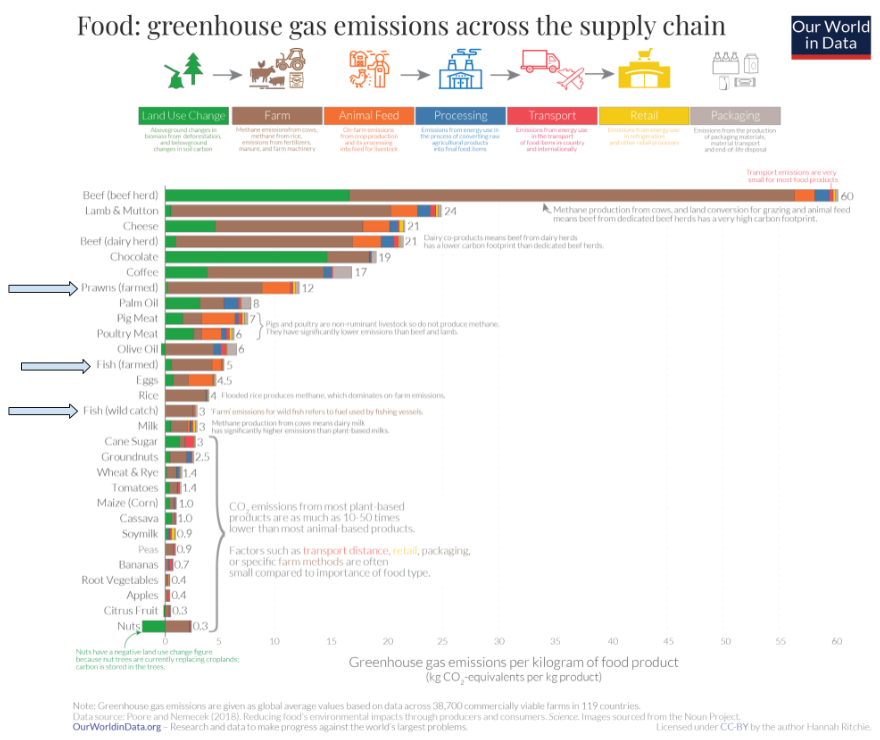
In this graphic (based on the data collected by Poore and Nemecek), you can see that both farmed and wild-caught fish rate similarly to milk, eggs, or olive oil. Not as climate-friendly as veggies, fruit, soybeans, and nuts, but pretty good! However, you can see that farmed prawns are getting closer to being a high-emissions food. If you’re routinely swapping chicken or turkey for prawns or lobster, you are likely increasing your carbon footprint.
This complicates our “eat more fish” message for climate-friendly diets. I don’t think we can expect everyone to remember specific species to eat or avoid, let alone whether they’ve been farmed or wild-caught. But as a dietitian I found the research from existing life-cycle assessments fascinating, and have come to a few take-aways so far:
- If you zoom out, on average seafood offers more nutrient density than beef, pork, or chicken, with a lower emissions profile than beef or pork. Usually when people swap a “terrestrial meat” for fish, it’s a win for the climate.
- Overall, the most climate-friendly “blue foods” are seaweed, bivalves like oysters, mussels, and clams, small fish like herring and mackerel, and salmon (especially pink and sock-eye).
- Among wild-caught options, most fish are more climate-friendly than any livestock, including chicken. Small fish like herring, sardines, anchovies, cod, haddock, salmon (especially farmed salmon), and trout are all climate-friendlier than chicken. However, shrimp, prawns, lobster, flounder, and halibut tend to have much higher emissions.
- Although the graphic above shows wild catch as more climate-friendly than farmed fish, this varies widely by species, so shouldn’t be assumed. Wild-caught bivalves, for example, generate more greenhouse gas emissions than farmed bivalves.
- Seafood to limit include shrimp, prawns, and lobster. We’re going to dig more into why eating these species is hard on the environment and the climate.
Luckily, many of the most nutrient-dense seafood options are also the most climate-friendly. The huge variety of fish and seafood options means that there’s a wide range of nutrients available from this food group, and it’s one way of meeting nutrient needs like protein, iron, zinc, vitamin B12, omega-3 fatty acids, and calcium. Fish can be an excellent complement to an otherwise plant-based diet that may be lower in micronutrients like iron.
How many of you regularly recommend or procure fish in your practice? Do you have go-to resources on the nutrients available across species? Send us an email and let us know!
P.S.
My subconscious must have been hard at work while I was writing this blogpost, because I woke up today with a favourite song from my 20s running through my head:
In a mucked up lovely river, I cast my little fly
I look at that river and I smell it and it makes me want to cry
Oh to clean our dirty planet–there’s a noble wish
But I’m putting my shoulder to the wind cause I wanna catch some fish
–“Spring Wind” by Jack Johnson
Here’s to more sustainable diets in 2025, and a cleaner planet,
Anneke