
This post was researched and written by our excellent RD volunteer, Sarah Dales, and edited by Anneke Hobson! Thank you Sarah!
You may have heard a lot about the EAT-Lancet report lately in the news, so we thought it would be helpful to provide a brief review – what is the Eat-Lancet report? And what does it recommend?
In 2019, “EAT”, a global non-profit foundation established by several non-profit organizations to help catalyze a food system transformation and The Lancet group, a collection of peer-reviewed journals including the well-known scientific journal The Lancet, worked together to release the first EAT-Lancet commission report The Commission included experts in human health, political science, environmental sustainability and agriculture from 16 countries. Its goal was bold, but framed as achievable and urgent: to provide guidance for a transformation towards healthy diets from sustainable food systems while addressing an industry responsible for approximately 30% of greenhouse gas emissions. It was based on analysis of previous research, modelling studies and expert opinion.
Last month, an update was released from an expanded Commission, now with an added central focus on justice. Its release renewed the call for a large-scale and coordinated effort (a “Great Food Transformation”) in order to meet the nutritional needs of 10 billion people globally by 2050 while staying within planetary boundaries. This includes meeting the UN Sustainable Development Goals (SDGs) and the Paris Agreement.
In addition to outlining the need for significant reductions in food waste and changes in food production practices, a key component of the first report was to move towards a plant-forward dietary pattern they called, the Planetary Health Diet (PHD). The PHD was born from an aim to optimize and balance both human and planetary health. What’s more, researchers reported that doing so could prevent 15 million premature deaths per year (up from 10 million in the 2019 report and based on new research assessing that a low “PHD index” score results in increased mortality).
Since the initial 2019 release, the EAT-Lancet report has had a significant impact on scientific discourse and has gained sizeable support in the academic community, but its recommendations have not been without criticism. An analysis of critiquing articles that followed the 2019 EAT-Lancet report suggested issues with micronutrient deficiencies, socioeconomic concerns including bias towards high income countries and lack of awareness of food affordability, accessibility and insecurity, feasibility, and disregard for environmental effects other than emissions. Other criticisms cited lack of reproducibility and failure to account for uncertainties.
Criticisms were not just directed at the report’s findings either. Threats and insults were levelled against the Commission members, thought to largely be a result of meat and dairy industry ‘mis-influencers’ and a PR campaign for the Animal Agriculture Alliance. Other backlash was targeted at the billionaire Norwegians who provided funding for the study, angered by the hypocrisy of the call for millions to reduce meat intake, while they travelled around by private jet and lived a lavish lifestyle.
Let’s take a closer look at the Planetary Health Diet and some of the criticisms of the dietary recommendations of the first Eat-Lancet report.
One Size Fits All
The PHD encourages adaptability, underscoring an emphasis on a plant-rich diet (whole grains, fruits, vegetables, nuts and legumes), with a reduction in animal-sourced foods (but not necessary elimination) and limitation of red and processed meats. This is depicted in a “plate model” (seen below), that is similar to Canada’s Food Guide, and is meant to apply to everyone older than 2 years of age. Walter Willlett, a professor of epidemiology and nutrition at Harvard T.H. Chan School of Public Health and co-chair of the Commission, has suggested that limiting dairy to once-a-day, red meat to once-a-week and eggs, poultry and fish to about twice-a-week, fits within the PHD pattern. Framed in this way, the PHD is quite similar to the Mediterranean diet pyramid. Alternatively, the commission also describes the PHD style of eating as “flexitarian” – plant-forward, diverse and adaptable.

While some may view the flexibility of the diet as a positive, many have criticized the one-size-fits-all approach and the lack of guidance on how to adapt it to different settings, both in terms of cultural acceptance (and personal preference), and diverse socioeconomic settings. And it’s hard to see how the model could be appropriate as a standard for some like Indigenous People who have specific local food traditions (e.g. Inuit who have a traditionally animal rich diet).
Tied to this critique was that most of the available evidence used was from studies done in Europe and the USA, with largely white populations. (Partially because long-term relevant studies in other countries don’t exist or aren’t as plentiful). This drew criticism of the report having a cultural bias towards white supremacy and “inherently links the PHD with the longstanding racist idea that Europe’s version of optimal health is everyone’s version of optimal health” (Shapiro 2025). For the 2025 report, the Commission had an expanded 35 country representation, however, the approach can still be seen as problematic without inclusion of the voices of local stakeholders affected by the guidelines.
For some populations, their baseline diet makes it feel like even “flexibility” may not be enough to make following it likely. Stubbendorff et al (2025) looked at average daily per capita food supply of different food groups compared to EAT-Lancet dietary targets (see image below), which showed many countries would need to make significant changes to amounts of food groups currently consumed.
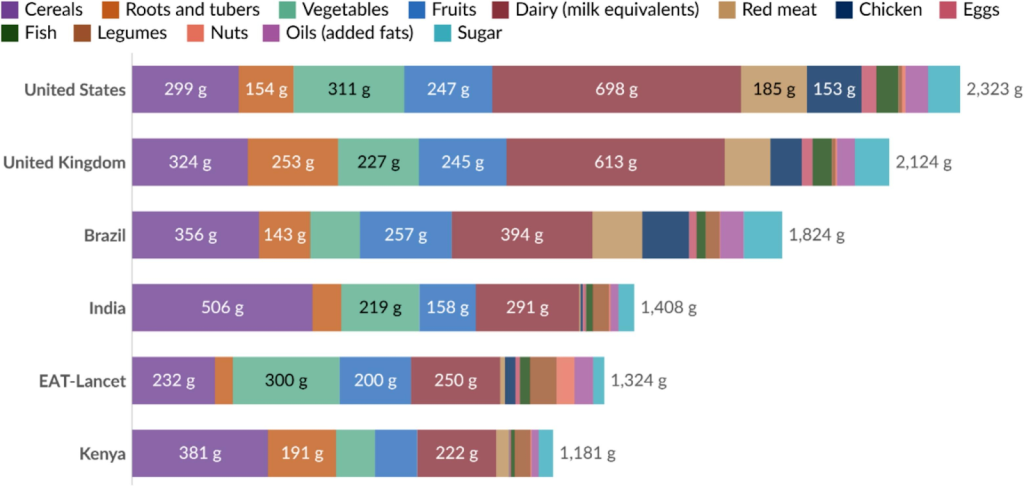
Not all dietary targets require reducing consumption either. Adopting the PHD would result in near universal increase in consumption of whole grains, fruits, vegetables and nuts, alongside select regional reductions in meat intake.
The 2025 report does acknowledge that some populations depend on livestock for their livelihood, while many others face undernutrition (more than 820 million people are without enough food), and obtaining adequate nutrients from plant sources alone for such populations would be difficult. It also identifies that a global reduction in added sugars and red meat should be driven primarily by reducing excessive consumption in wealthier countries, “as the wealthiest 30% of people drive more than 70% of food-related environmental impacts”.
Micronutrient Inadequacies
As dietitians, we know that moving towards a plant-rich diet requires planning to ensure adequate micronutrient intake and despite this (and for a variety of reasons), the need for some supplements can often follow. Assessment of Canadians’ nutrient intakes have shown we already have a high prevalence of inadequate intake for potassium, Vitamin A, Vitamin C, Magnesium and fibre – the latter four of which are typically consumed adequately on a plant-rich diet. On the other hand, Vitamin B12, iron, calcium and Vitamin D are key nutrients needing special attention on a primarily plant-based diet. Unfortunately, there is no mention of these considerations in the PHD.
Beal et al (2023) analyzed the PHD and found that following it may lead to unintended micronutrient deficiencies for some groups. For example, those of reproductive age had estimated intakes of Vitamin B12, calcium, iron and zinc below recommendations when following the diet. On the flip side, the same analysis estimated that intakes of folate and vitamin A were essentially adequate for adults including those of reproductive age. Beal et al went on to suggest some modifications to the PHD to meet micronutrient needs without supplementation: increase animal source foods (from 14% to 27% of total kcal) and reduce dietary phytate (whole grains, pulses, nuts) to improve iron and zinc absorption. On a global scale they stated this would lead to a decrease in red meat intake, while intake of eggs, fish, shellfish and dairy products would increase.
Despite these suggested modifications, the authors note that tradeoffs will exist when trying to balance nutrient adequacy, environmental effects and minimizing risk of chronic disease. The 2025 report touches on this as it states that health outcomes related to food intakes, and not nutrient adequacy, are the primary consideration. (Although nutrient adequacy is still important and included in the analyses). Considering these trade-offs, supplements or a role for fortified foods could be a reasonable addition to a diet that otherwise meets criteria for human and planetary health. Various supplements are already recommended in many parts of the world to help meet the needs of specific groups. For example, WHO recommends routine iron and folic acid supplementation in pregnancy.
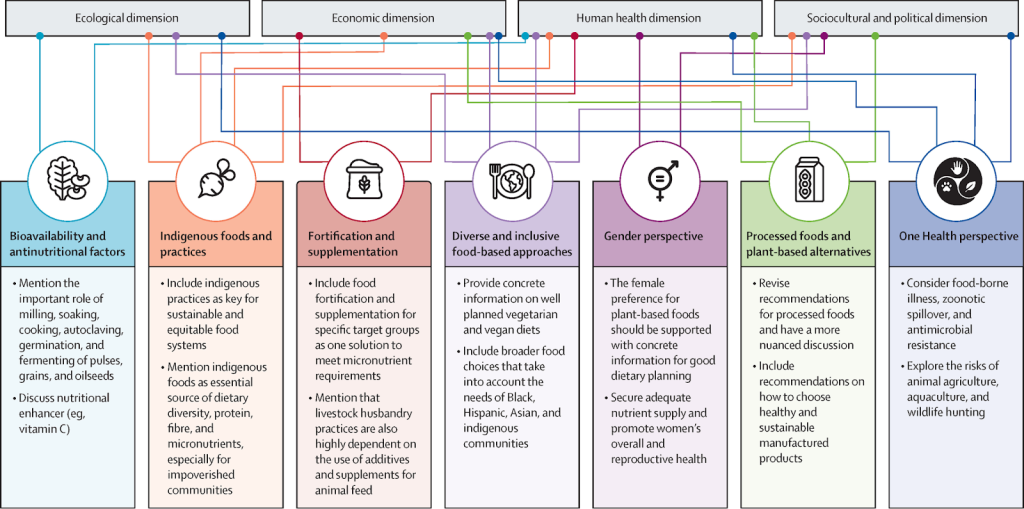
Prior to the release of the updated EAT-Lancet report, Klapp et al (2025) made recommendations to address the shortfalls of the PHD while maintaining the plant-forward perspective (see image below). They emphasized that efforts across disciplines should be focused on addressing shortfalls of the PHD rather than proposing solutions that are not as viable or continuing with business as usual. So, while the Commission may be well-aware of some of these strategies – combining Vitamin-C rich foods with plant-based iron sources is mentioned in the 2025 report – they could do a better job of bringing these points forward.
Another point of critique is the calorie intake per day that the report uses to determine nutrient adequacy – 2500kcal/d (2019) and 2400kcal/d (2025). These were based on global average per capita energy intake with a moderate-to-high level of physical activity. This has been deemed unrealistically high for many and with no additional recommendations on how to make adjustments or what to pay more attention to.
Questions of affordability
In terms of affordability, it seems to be largely dependent on the context. While a predominately plant-based diet may actually reduce consumer costs in high- and upper-middle-income countries, a global modelling study estimated the cost of the PHD exceeded household per capita income in many low-income countries. This makes sense when some populations would actually need to increase the amount of food they consume to meet the recommendations.
While findings suggest affordability, the report acknowledges that food prices may actually increase alongside food production changes. In Canada, with food bank usage having doubled since 2019 (1/4 of the population is food insecure), it’s challenging to consider many moving towards the PHD without strong social safety nets in place to address poverty.
The EAT-Lancet Commission report goes on to provide 5 strategies for achieving planetary health diets for the world’s population by 2050:
- Seek international and national commitment to shift toward healthy diets.
- Reorient agricultural priorities from producing high quantities of food to producing healthy food.
- Sustainably intensify food production to increase high-quality output
- Strong and coordinated governance of land and oceans
- At least halve food losses and waste, in line with UN Sustainable Development Goals
Interested in more details? You can read the full report here: https://www.thelancet.com/journals/lancet/article/PIIS0140-6736(25)01201-2/fulltext
Takeaway
As a strict guide meant to apply to the entire population of Earth, the EAT-Lancet Commission report and PHD has shortfalls that are bound to receive criticism. Viewing it more as a framework meant to help influence policy, promote further research and generate discussion, it seems to be having an impact. At a time when it feels like we need to keep the reality of climate change at the top of mind, it highlights that our food system impacts both human and planetary health and is in need of improvement. In the end, despite its flaws, two of the report’s key points are the same as what Dietitians for Climate Action has been championing – move towards a plant-rich diet and reduce food waste.
References
Ahmed M, Praneet Ng A and L’Abbe MR. Nutrient intakes of Canadian adults: results from the Canadian Community Health Survey (CCHS)-2015 Public Use Microdata File. Am J Clin Nutr. 2021 Sep 1;114(3):1131-1140), Retrieved from: https://pmc.ncbi.nlm.nih.gov/articles/PMC8408873/
Beal T, Ortenzi F and Fanzo J. Estimated micronutrient shortfalls of the EAT-Lancet planetary health diet. The Lancet Planetary Health. 2023 Mar; 7(3): 233-237, Retrieved from: https://www.sciencedirect.com/science/article/pii/S2542519623000062
Carlile C. PR campaign may have fuelled food study backlash, leaked document shows. The Guardian. 2025 Apr 11. Retrieved from: https://www.theguardian.com/environment/2025/apr/11/pr-campaign-may-fuelled-food-study-backlash-leaked-document-eat-lancet
“Frequently Asked Questions”. EAT Forum. Retrieved from: https://eatforum.org/eat-lancet/lancet-explained/frequently-asked-questions/
Klapp AL, et al. Recommendations to address the shortfalls of the EAT-Lancet planetary health diet from a plant-forward perspective. The Lancet Planetary Health, 2025 Jan. 9(1): E23-E33. Retrieved from: https://www.thelancet.com/journals/lanplh/article/PIIS2542-5196(24)00305-X/fulltext
“Meat vs EAT-Lancet: The dynamics of an industry-orchestrated online backlash”. Changing Markets Foundation. September 2025. Retrieved from: https://changingmarkets.org/report/meat-vs-eat-lancet-the-dynamics-of-an-industry-orchestrated-online-backlash/
“New landmark EAT-Lancet Commission warns food systems breach planetary limits”. EAT Forum. October 3, 2025. Retrieved from: https://eatforum.org/update/eat-lancet-commission-warns-food-systems-breach-planetary-limits/
Rezaei, M. The EAT-Lancet Commission on healthy, sustainable and just food systems: Is it enough to transform food systems? ODI Global. 2025 Oct 7. Retrieved from: https://odi.org/en/insights/the-eat-lancet-commission-on-healthy-sustainable-and-just-food-systems-is-it-enough-to-transform-food-systems/
Rockstrom et al. The Eat-Lancet Commission on healthy, sustainable, and just food systems. The Lancet Commissions. 2025 Oct 11. 406(10512): P1625-1700. Retrieved from: https://www.thelancet.com/journals/lancet/article/PIIS0140-6736(25)01201-2/fulltext
Roeder, Amy. This dietary pattern could save lives and the planet. Harvard T.H. Chan School of Public Health. 2025 Oct 8. Retrieved from: https://hsph.harvard.edu/news/this-dietary-pattern-could-save-lives-and-the-planet/
Schapiro, J. Breaking down the 2025 EAT-Lancet Commission Report. Hunter College New York City Food Policy Center. 2025 Nov 4. Retrieved from: https://www.nycfoodpolicy.org/breaking-down-the-2025-eat-lancet-commission-report/
Stubbendorff A, et al. Mini-review of the Eat-Lancet planetary health diet and its role in cardiometabolic disease prevention. Metabolism. 2025 Nov, volume 172, 156373. Retrieved from: https://www.sciencedirect.com/science/article/pii/S0026049525002422
Tulloch A, et al. How the EAT-Lancet Commission on food in the Anthropocene influenced discourse and research on food systems: a systematic review covering the first 2 years post-publication. The Lancet Global Health. 2023 July, 11(7): E1125-E1136. Retrieved from: https://www.thelancet.com/journals/langlo/article/PIIS2214-109X(23)00212-7/fulltext
Willett W et al. Food in the Anthropocene: the EAT-Lancet Commission on healthy diets from sustainable food systems. The Lancet Commissions. 2019 Feb 2, 393(10170): P447-492. Retrieved from: https://www.thelancet.com/journals/lancet/article/PIIS0140-6736(18)31788-4/fulltext