
A common recommendation from sustainability groups is to avoid ultra-processed foods. According to one of the biggest, most recent surveys of dietitians (in the U.S.), our profession believes that “fewer ultra-processed foods” will have the greatest impact on environmental sustainability. Do we have this right? The logic is pretty intuitive: these foods don’t have much nutritional value, so producing them seems like a waste of resources (land, water, fertilizer, pesticides, etc.). Some sustainability groups say that everyone should avoid or minimize these foods, and others go further and propose taxes or bans (e.g. a sugar-sweetened beverage tax). I can completely understand this impulse. It’s true that the nutrient value of ultra-processed foods tends to be low, and that populations could be healthier with less of them in the food environment.
But I’m always cautious about this kind of intuitively appealing strategy before looking at the data and research, especially when it’s a conveniently aligned message for health and sustainability. So this month we set out to answer the question: if you eat fewer potato chips and pop, will you be reducing your food emissions?
In most life-cycle assessment studies, greenhouse gas emissions are calculated for whole foods like veggies and fruit, nuts, legumes, meats, and dairy products. But if we look at what people actually buy at a grocery store, packaged and prepared foods make up around three-quarters of food purchases in high-income countries (Gaines et al 2023). The climate impacts of these products are less researched. It’s more complicated for researchers to work out the impacts of processed foods, especially those that have the longest list of ingredients, and without knowing exactly how much of each ingredient is in a product.
When we look at the measured climate impact of ultra-processed foods, the findings are surprising, and results are mixed. Some studies, like this one, do find that reducing the amount of ultra-processed foods leads to a diet with a smaller environmental footprint. But more often, research doesn’t bear this out. Take a look at the graphic below, which shows “confectionery,” “sugars,” “snack foods” and “convenience foods” as being pretty low emissions compared to other foods (graphic from Gaines et al 2023):
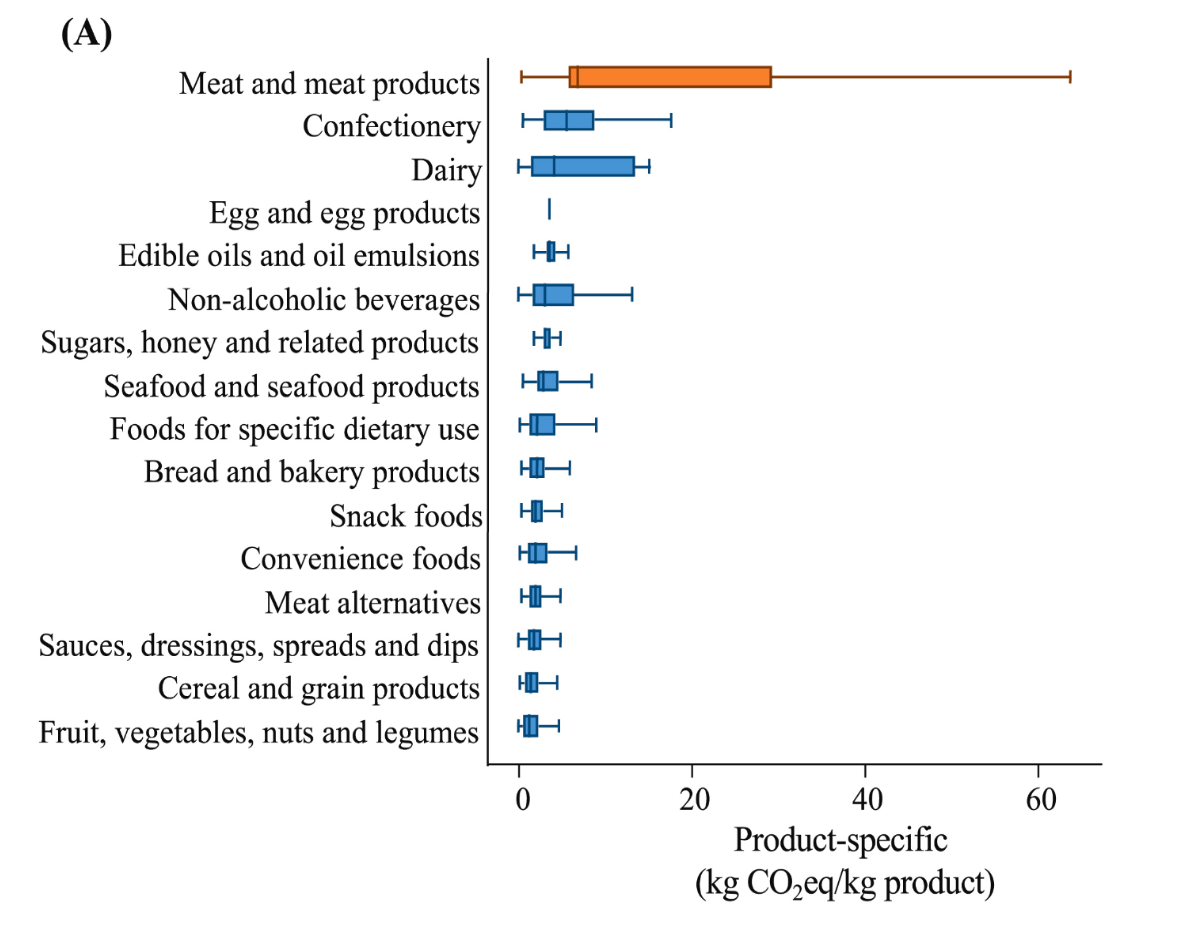
Potato chips, for example, are climate-friendly, while minimally processed or whole foods can be much more emissions-intensive, with beef, lamb, and lobster generating the greatest amounts of emissions (among other environmental impacts). You’ll notice that “confectionery” has more of a climate impact than “snack foods” in the above graphic. This category generates more emissions mainly because cocoa and palm oil are common ingredients in those foods.
Overall, though, sugar, oil, and other ingredients used in highly processed foods can be produced pretty efficiently, without using much land, time, or other resources. If you eat less candy, chips, cookies, and sugary drinks, and replace them with more meat, you are very likely increasing your carbon footprint. This is another reason we often say that a sustainable diet is not always a healthy diet, and a healthy diet is not always sustainable.
Whether ultra-processed foods have a significant carbon footprint also depends on what you consider to be an “ultra-processed food”. You’re probably aware that Canada’s Food Guide uses the term “highly processed foods” for this category. Usually in published studies, though, this is done based on the NOVA system, which groups foods into four categories:
NOVA1: unprocessed or minimally processed foods, such as vegetables, fruits, eggs, legumes, or nuts.
NOVA2: processed culinary ingredients, such as oils, fats, salt, and sugar
NOVA3: processed foods, such as canned legumes, tomato paste, salted nuts, or “freshly-made” cheese.
NOVA4: ultra-processed foods, such as ice cream, candy, soft drinks, packaged bread, and pastries
This classification system might seem straightforward, but it can sometimes be ambiguous to determine whether a food is “processed” or “ultra-processed”. It’s also not always a clear-cut recognition of nutritional quality. For example, fruit juice with no added sugar would be a minimally processed food (NOVA1), but it’s not necessarily the healthiest beverage choice or comparable to eating a piece of fruit. On the other hand, packaged bread is given as an example of a food within the NOVA4 category, meaning that a loaf of whole grain bread from the grocery store (generally a healthy food choice) would be considered an ultra-processed food.
Dietitians often note (and lament) that ultra-processed or highly processed foods are cheaper than whole foods. Especially when you consider them on a dollar-per-calorie basis, ultra-processed foods are a much cheaper way to get calories than whole, unprocessed foods. When you add up price, convenience, and taste, ultra-processed foods meet lots of different needs for people. While there are definitely downsides to them, climate change isn’t one.
That said, there are some foods that contribute to climate change AND are not doing much for our health: processed meats. Snacks like beef jerky and bacon don’t have much nutritional value and they’re hard on the environment to produce. So while the research doesn’t support the general message that ultra-processed foods are bad for the environment, certain foods in this category do have a combined negative impact on health and the climate. For other ultra-processed foods, climate change won’t be affected by bans, taxes, or other incentives to stop eating them. In fact, if people switched from eating cookies or potato chips to eating more meat, food emissions would go up.
So what’s the upshot here? We’re not saying anyone should eat more ultra-processed foods to lower their climate impact. Most dietitians already follow the general principle of “all foods fit,” which absolutely applies to ultra-processed foods. I think this shows that we can keep the message of not forbidding anything, but moderating them when they’re a problem for people’s health. You might be thinking: what’s the point of this blog post if we’re going to keep the same nutrition messages we’ve already established? I think this information is important for a few reasons:
-
Dietitians currently believe that reducing ultra-processed foods is the most impactful strategy to make diets more sustainable, but this isn’t accurate based on the existing research! Studies show again and again that plant-rich diets and reduced food waste are much more effective at reducing food emissions.
-
We’ve written previously about the connection between sustainability and eating disorders. If some people are avoiding ultra-processed foods in a way that is extreme or interfering with their relationship with food because they’ve heard this message about the environment, they need to know this information. Rigid rules and restrictions around chips or cookies are not going to benefit the environment.
-
If we’re looking at sustainability, focusing efforts, attention, and resources on reducing ultra-processed foods will take resources away from more impactful strategies, where we can much more effectively reduce the emissions generated by the food system.
-
Showing that we know the findings on sustainable food and actually follow it helps to build and maintain trust with the public, governments, and people working in sustainability. Knowing these nuances helps us to be effective in climate action and to show that we base recommendations on scientific research, rather than messages that feel intuitively true.
Sometimes nutrition and sustainability don’t align. If you’re working on a sustainability project, or working to integrate climate considerations into your RD role, you’re much better off promoting plant proteins or showing people how to reduce food waste at home than telling them not to eat ultra-processed foods.
References
Aceves-Martins et al. (2022). Nutritional Quality, Environmental Impact and Cost of Ultra-Processed Foods: A UK Food-Based Analysis. Retrieved from https://www.ncbi.nlm.nih.gov/pmc/articles/PMC8948822/
Food + Planet and Today’s Dietitian. (2023). Sustainability and Food Insights Dietitian Survey. Retrieved from https://drive.google.com/file/d/1LGNZr36cZDxHjtyJsp3INg_TDsYyKaCY/view
Gaines et al. (2023). “A novel approach to estimate product-specific greenhouse gas emissions for 23,550 Australian packaged foods and beverages.” Retrieved from https://www.sciencedirect.com/science/article/pii/S0959652623029748
Poore and Nemecek. (2018). Reducing food’s environmental impacts through producers and consumers. Retrieved from https://www.science.org/doi/10.1126/science.aaq0216